
Automation in Hospitality: Setting the Pace for 2026
As hotels close out 2025 and prepare for 2026, automation in hospitality has become one of the strongest drivers of operational change. The industry now faces a rare moment where technology maturity, guest expectations, and labour realities are fully aligned. Automation is no longer a future concept. It is the present engine behind higher productivity, smoother operations, and stronger guest satisfaction.
Yet automation today is more than streamlined check-ins, smart-room controls, or robotic vacuums. It sits at the centre of a major industry transformation, touching every department and shaping how hotels deliver service, build resilience, and scale profitably.
This article explores how automation in hospitality has evolved, why it matters more than ever, and how hoteliers can use it to thrive in 2026.
A New Era of Expectations
Travelers no longer compare hotels only to other hotels. Their expectations come from the frictionless digital experiences they use every day—banking apps, ride-hailing tools, and seamless e-commerce journeys. Guests want hotel experiences that feel personalised, anticipatory, and easy. They also expect communication to be immediate and accurate.
Automation enables this.
It powers proactive messaging, reduces wait times, supports instant service confirmations, and helps hotels maintain consistency even during staff shortages.
The new guest journey includes:
- Digital check-in with mobile key delivery
- Automated pre-arrival messages tailored to travel purpose
- Predictive room assignment based on preferences
- On-property chatbots for immediate solutions
- IoT-powered rooms that remember guest behaviour
Automation in hospitality creates these experiences at scale. It allows hotels to deliver more, faster, with fewer interruptions.
Staff Shortages Are Still a Reality
Despite global recovery, labour shortages remain widespread. Many experienced hospitality workers left the industry during the pandemic, and younger generations prioritise flexibility, predictable schedules, and digital workflows. Hotels that rely on manual processes find it harder to attract talent.
Automation does not replace hospitality roles—it elevates them.
It removes repetitive tasks such as:
- Manual reconciliations
- Night audit checks
- Data entry
- Routine maintenance tracking
- Housekeeping status updates
- Simple guest inquiry responses
When technology handles these tasks, employees can focus on the core of hospitality: human interaction. This shift builds workplace satisfaction and helps hotels retain talent in a competitive labour market.
Department-by-Department Transformation
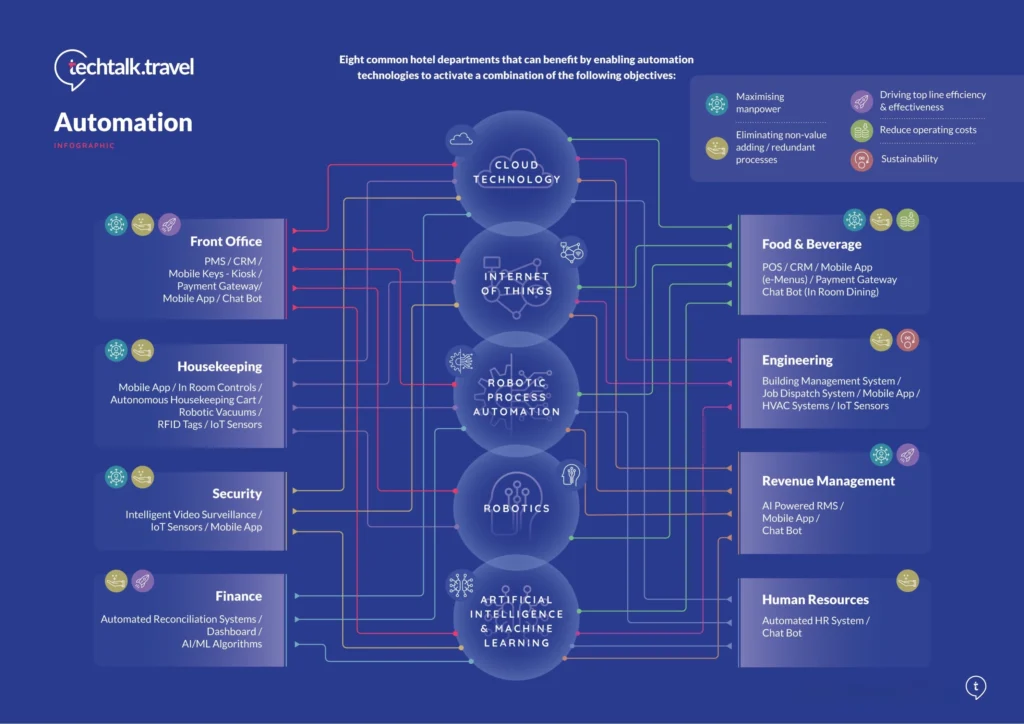
The hospitality industry now understands that automation only delivers full value when it extends beyond one system or one department. Modern hotels use automation as a connected ecosystem that links operations, finance, service, and guest experience.
Front Office
Front-office automation has moved far beyond kiosk check-ins. PMS, CRM, mobile keys, smart payment gateways, and AI-powered guest messaging work together to reduce queueing, eliminate manual verification steps, and minimise staff workload.
Teams can now focus on solving complex guest needs rather than managing paperwork.
Housekeeping
Housekeeping remains one of the most labour-intensive areas in hotels. Automation now supports this department through:
- Mobile housekeeping apps
- Smart in-room controls
- Robotic vacuums
- RFID-enabled linen tracking
- Autonomous housekeeping carts
- IoT sensors for energy and occupancy
This creates real-time transparency around room status, workload, and productivity. It also reduces physical strain on staff and shortens turnaround times.
Food & Beverage
Digital menus, payment gateways, mobile ordering, and automated POS-to-kitchen flows dramatically reduce wait times and human errors.
Smart scheduling, inventory alerts, and demand forecasting minimise waste and improve profitability.
Automation in hospitality is especially powerful here, because each improvement compounds across multiple service moments.
Engineering
Engineering and maintenance are now data-driven. IoT sensors and building management systems alert teams to issues before they become breakdowns. Automated job dispatching ensures urgent tasks are prioritised.
Predictive maintenance is replacing reactive maintenance, extending asset life and lowering operating costs.
Revenue Management
AI-powered RMS platforms have become essential. Automated rate optimisation, demand forecasting, and competitor analysis run continuously.
Revenue leaders no longer spend hours building spreadsheets—they spend time applying strategy.
Security
Intelligent video surveillance, automated alerts, mobile access logs, and IoT sensors elevate safety while reducing manual oversight.
Automation enhances—not replaces—human security capabilities.
Finance
Automated reconciliation, dashboards, AI-assisted forecasting, and daily reporting reduce the burden on financial teams.
Finance automation also improves accuracy, enabling quicker and more confident decision-making.
Human Resources
Digital HR systems, automated onboarding, time tracking, and AI-supported recruitment help hotels handle high turnover and seasonal staffing.
Recruitment speed becomes a competitive advantage, especially in markets with persistent shortages.
Automation as a Cultural Shift
Technology alone will not deliver transformation. Hotels must adopt a culture that rewards experimentation, continuous improvement, and cross-departmental collaboration. Automation in hospitality succeeds when:
- Leadership supports operational change
- Teams understand the “why” behind new tools
- Workflows are redesigned, not simply automated
- Data is centralised and accessible
- Staff receive ongoing, practical training
- Success metrics are clear and shared
Forward-thinking hotels now treat automation as a core business capability, just like revenue management or brand marketing.
Sustainability and Long-Term Value
Hotels are under pressure to reduce energy use and operate sustainably. Automation supports this by optimising:
- HVAC settings based on occupancy
- Water usage monitoring
- Energy consumption analytics
- Inventory and waste tracking
- Predictive maintenance
- Linen management cycles
Sustainability is no longer separate from efficiency. Automation ties them together.
Preparing for 2026: What Hoteliers Must Focus On
As we move into 2026, hoteliers should prioritise five strategic actions.
1. Build a Connected Technology Stack
Automation works best when systems share data. Building a connected stack—PMS, CRM, RMS, POS, and IoT—is now essential for meaningful impact.
2. Embrace AI-Driven Decision Making
AI is no longer optional. From forecasting to messaging, AI gives hotels the ability to react faster and operate with confidence.
3. Redesign Staff Roles for Higher Value
Automation frees employees to deliver meaningful service. Hotels should reposition roles to focus on creativity, problem-solving, and personal connection.
4. Improve Data Quality and Governance
Automated processes depend on good data. Consistency, cleanliness, and integration must be ongoing priorities.
5. Communicate the Benefits to Guests
Guests appreciate transparency. When hotels explain how automation improves service and privacy, trust grows.
Final Words
Automation in hospitality is no longer a trend. It is the foundation that supports the modern hotel experience. As we move from 2025 into 2026, hotels that embrace automation will be better equipped to meet rising expectations, manage labour challenges, operate sustainably, and compete with agility.
The hospitality industry has always been about people. Automation enhances this truth by giving staff more time and energy to deliver genuine, heartfelt service. When used wisely, it does not remove the human element—it strengthens it.
Takeaways
- Automation in hospitality now supports every department, from front office to finance.
- Guest expectations require frictionless journeys, and automation delivers them at scale.
- Labour shortages continue, making automation essential rather than optional.
- Connected systems and AI-driven insights create major performance gains.
- Hotels that invest now will enter 2026 with stronger resilience, lower costs, and higher guest satisfaction.
Hi, this is a comment.
To get started with moderating, editing, and deleting comments, please visit the Comments screen in the dashboard.
Commenter avatars come from Gravatar.